
HUE · Head-Up Eyewear
Your world, upgraded.
Useful information, closer to the moment you need it. HUE brings together modular eyewear and companion software to put navigation, communication and contextual assistance in your line of sight.
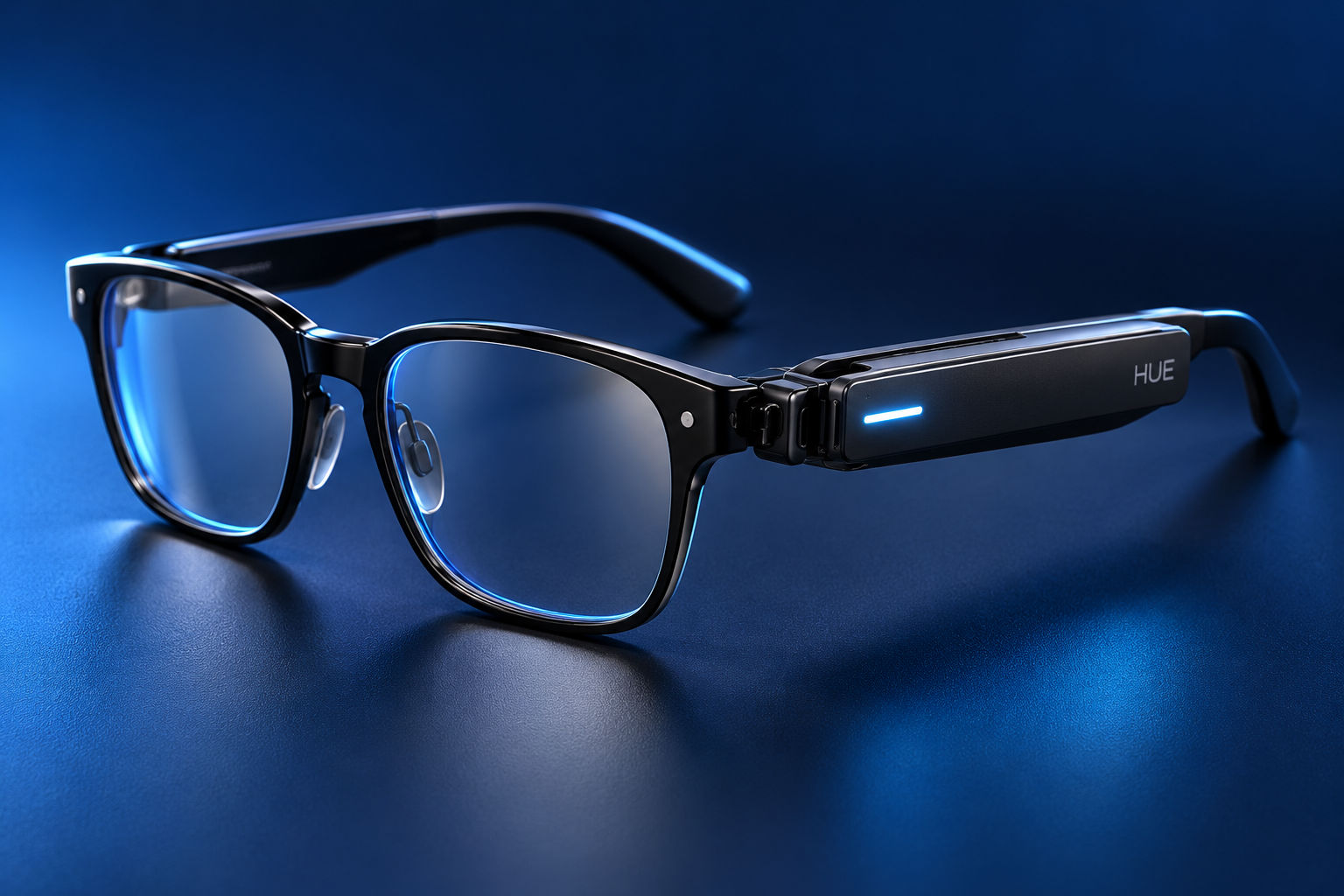

The experience
Stay in the moment. Keep what matters in view.
The experience we are building is simple: glance, get what you need, carry on. HUE is designed for the moments when stopping to look at a phone breaks your flow — walking a new route, talking with someone, or working with your hands.
At-a-glance navigation
Turn cues and arrival details sit quietly in view, so you can keep your head up and your phone in your pocket.
Communication & translation
Designed to surface messages, call details and live translation captions without breaking the conversation in front of you.
Practical work & learning
Step-by-step checklists, reference values and training prompts beside the task, so your hands stay on the work.
Optional AI assistance
Cited references, drafted notes and summaries that you review and approve. The assistant suggests; you decide.
Product design
Built around your glasses.
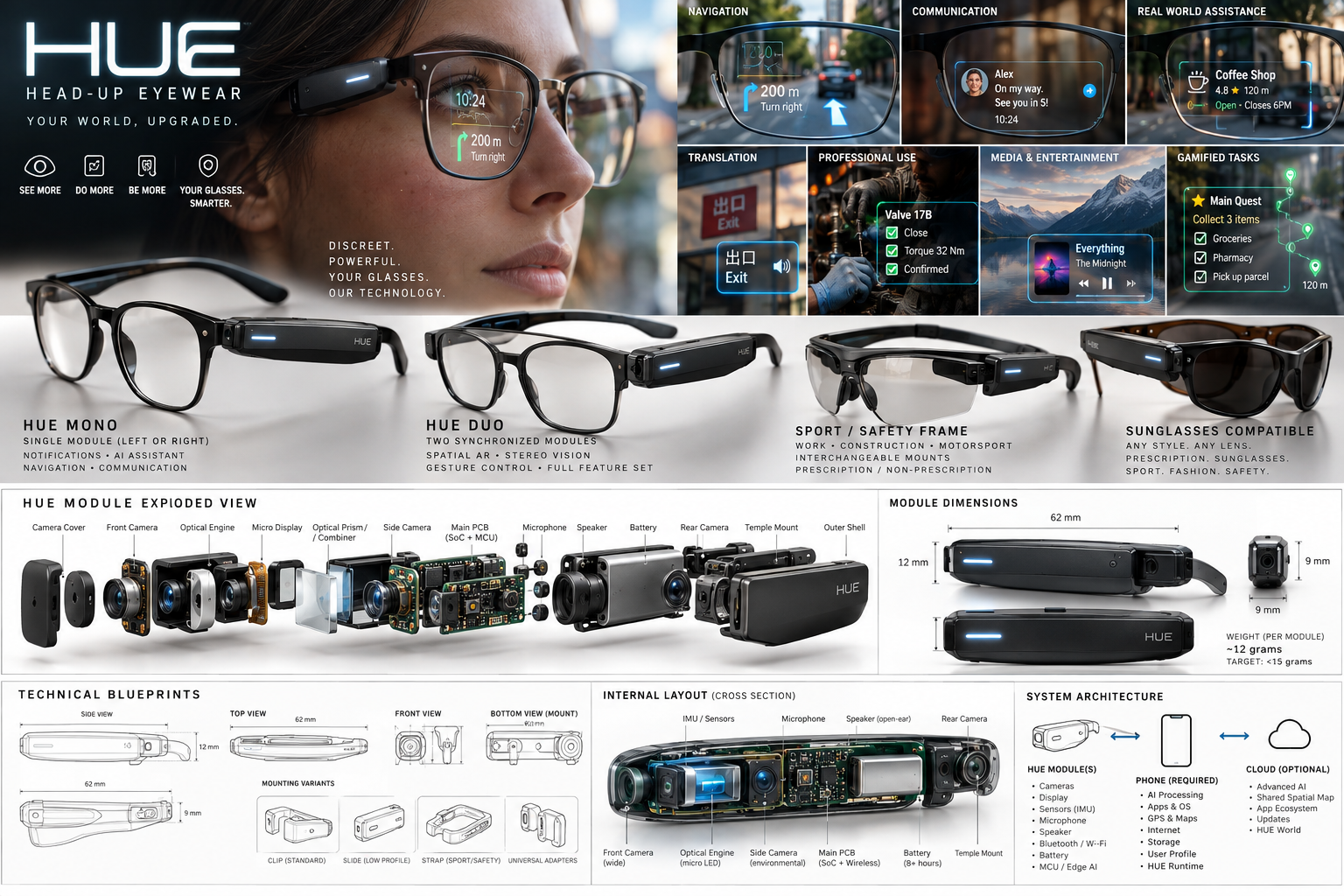
Rather than asking you to switch to new frames, HUE is designed as a modular attachment for eyewear you already wear. Frame and lens compatibility will be confirmed as development progresses.
HUE Mono
One clip-on module on your own glasses — the focused starting direction for a light, glanceable display.
HUE Duo
Two synchronised modules for a richer future experience, developed after Mono.
Modular mounts
Mounting directions for everyday frames, sport and safety eyewear, and sunglasses.
Phone companion
Your phone does the heavy lifting, keeping the module small and the experience personal.
Designed to be easy to start
- 1Attach
- 2Connect
- 3Calibrate
- 4Personalise
- 5Use
Companion software
Your display, your rules.
The HUE companion app — planned for Android and iOS — is where you shape the experience: what appears, when, and who can access what.
Choose your HUD layers
Navigation, messages, tasks, translation, media and more.
Personalise what you see
Decide what appears, where it sits and when it shows.
Manage permissions
Clear controls over what each layer and any capture feature can access.
Assistant under your control
Drafts and suggestions you review before anything happens.
Industry workflows
HUE Studio: a catalogue of HUD apps and work modes for specific trades.
Device & status
Connect modules and check battery, connection and fit at a glance.
Where HUE helps
One interface, many moments.
Everyday life
Find your way, follow a conversation in another language and stay on top of messages — while staying present.
Professional work
For technicians and field teams: the next step or reference value in view, without stopping to check a screen.
Training
Guided prompts for trainees on practical tasks, with supervisors able to follow progress.
Partners & investors
Build the next interface with us.
HUE is a modular hardware and software ecosystem: eyewear modules, a companion app and workflow tools that grow together. Joint development lets partners shape the demonstrator, the first targeted use cases and the platform around them. We welcome conversations with:
Engineering & optics partners
Display, optics, power and industrial design expertise to help shape the first demonstrator.
Start a conversationOrganisations shaping future pilots
Teams with practical work or training needs who want HUE designed around real workflows.
Start a conversationStrategic & investment conversations
Partners interested in the long-term hardware and software ecosystem.
Start a conversation
In concept development. We are shaping the first demonstrator and partner conversations. Commercial availability will follow development and validation.
Technical
Explore the engineering direction
For engineers and partners: the proposed architecture, current design targets and the milestones ahead. Targets are conceptual and not yet measured.
Architecture and connectivity
Eyewear
Bounded display rendering, controls and sensors, power and thermal protection, and blanking the display on a fault.
Phone
Task logic, permissions, caching and sync, optional processing and configuration.
Optional cloud
Administration, approved content and fleet sync. Basic usefulness should not depend on an always-on connection.
Offline, versioned task packs; visible freshness and connection state; explicit acknowledgement from the wearer; and human review of anything generated.
Intended AI support: retrieving cited references, drafting notes and reports, and transcription the wearer starts. No autonomous diagnosis, triage or hazardous decisions.
Interaction concepts: voice and audio, touch in the phone app, and research-stage gaze, blink and gesture input for Duo. Engineering recommends a simpler Mono glanceable display first; Duo, spatial mapping, cameras and eye tracking are separate feasibility gates.
Technical design targets
Working design targets from concept and feasibility work — not measured specifications.
Scroll the table sideways to see all columns.
| Area | Concept / target | Engineering status |
|---|---|---|
| Module envelope | 62 × 12 × 9 mm | Fit, thermal and optical packaging not validated. |
| Module mass | Approx. 12 g, target under 15 g per module | Measured prototype mass has not been verified in the supplied material. Per module, not whole-eyewear mass. |
| Display | Micro-LED or LCOS; monocular first, binocular later | Display engine not selected. |
| Field of view | Under optical evaluation | Early studies use different ranges (roughly 10–25°); no value is fixed. |
| Resolution / brightness | 720p-equivalent per eye; 1000+ nits | Concept targets, not measurements. |
| Connectivity | Phone-mediated Bluetooth, optional Wi-Fi | Engineering favours compact Bluetooth LE text, icon and card updates with cached assets. No video over Bluetooth. |
| Runtime | 6–8+ hours explored across working studies | Duty-cycle and battery validation pending; no rated runtime. |
| Sensors | Motion, ambient light, wear detection | Eye tracking is an optional, gated research path. |
| Camera | Concept: 1–3 cameras per module | Later optional research direction; the proposed first Mono baseline omits a camera for power and privacy. |
| Audio | Open-ear audio, noise-cancelling microphone | Acoustics and capture controls unvalidated. |
| Lens directions | Passive LensSkin optical patch; active tint/focus; HUE Vision programmable prescription | Future research concepts. No prescription-compatibility or optical-performance claims. |
| Environmental | IP54; −10 °C to 45 °C | Targets only; not tested, rated or certified. |
Development milestones
Milestone gates, not dates. Each step proceeds when the previous one produces evidence; progression depends on documented results.
- Gate 1
Define users and workflows
- Gate 2
Compare optical paths
- Gate 3
Phone and device demonstrator
- Gate 4
Supervised fit and readability trials
- Gate 5
Engineering validation (EVT)
- Gate 6
Design validation (DVT)
- Gate 7
Pilot production (PVT)
- Gate 8
Release, only after evidence